Key takeaways
- Prioritize named engineers and your Git repos from sprint one
- Ask for case studies matching your domain complexity
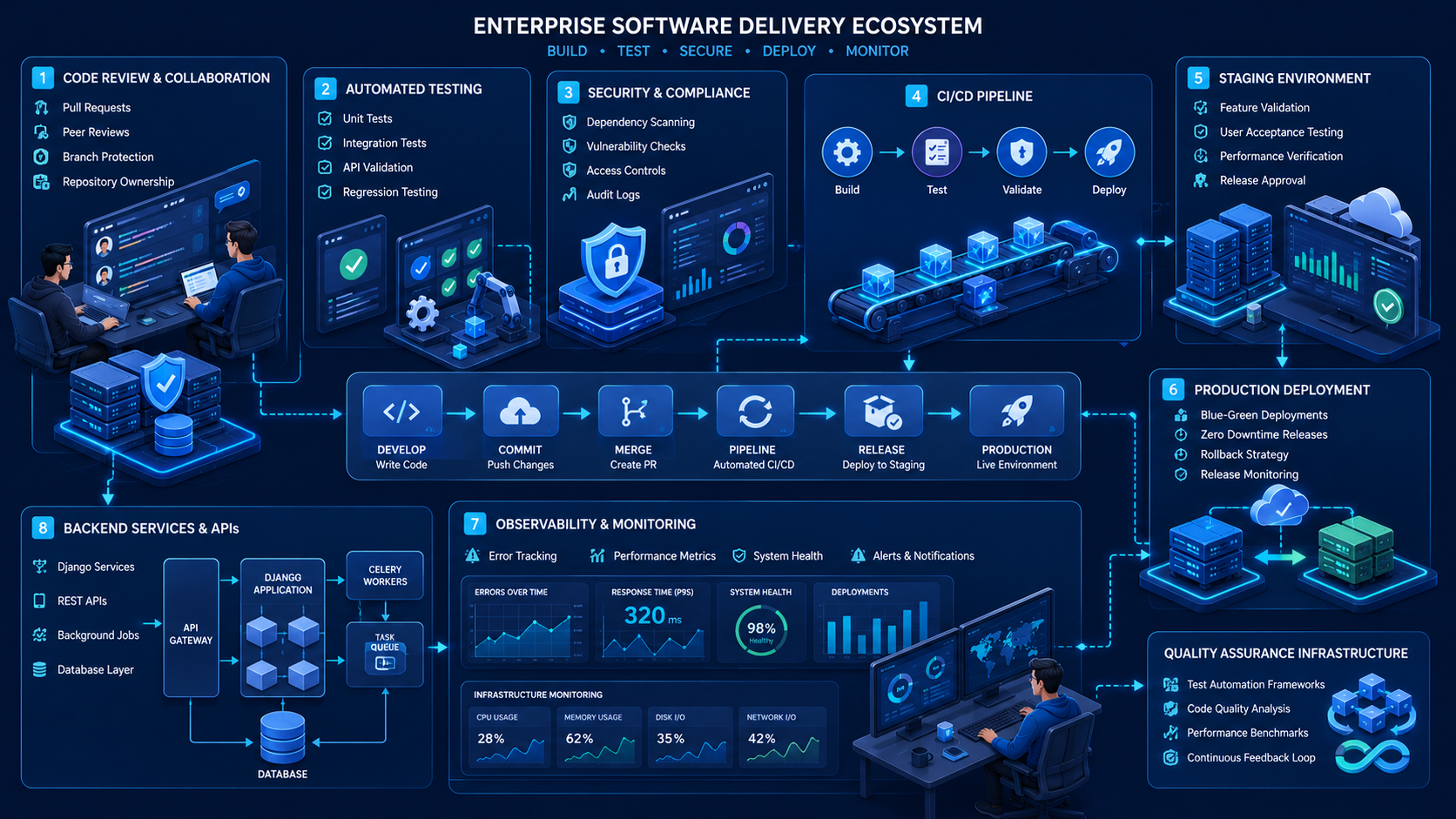
- Demand staging, CI, and monitoring—not production-only testing
- Use paid discovery to de-risk before large contracts
- Compare total cost of ownership including your team's time
- Walk away from fixed bids on vague scope
Article content
Why choosing a Django development company is different in 2026
Django remains the default backend for B2B SaaS, marketplaces, and internal tools where security, admin workflows, and predictable delivery matter more than chasing the latest JavaScript framework. But not every agency that lists Django on its homepage ships production systems with tests, staging parity, and Search Console–clean URLs. Founders in the US, UK, and Europe evaluating a Django development company in 2026 should optimize for maintainability and honest scoping—not slide decks featuring generic CRUD demos.
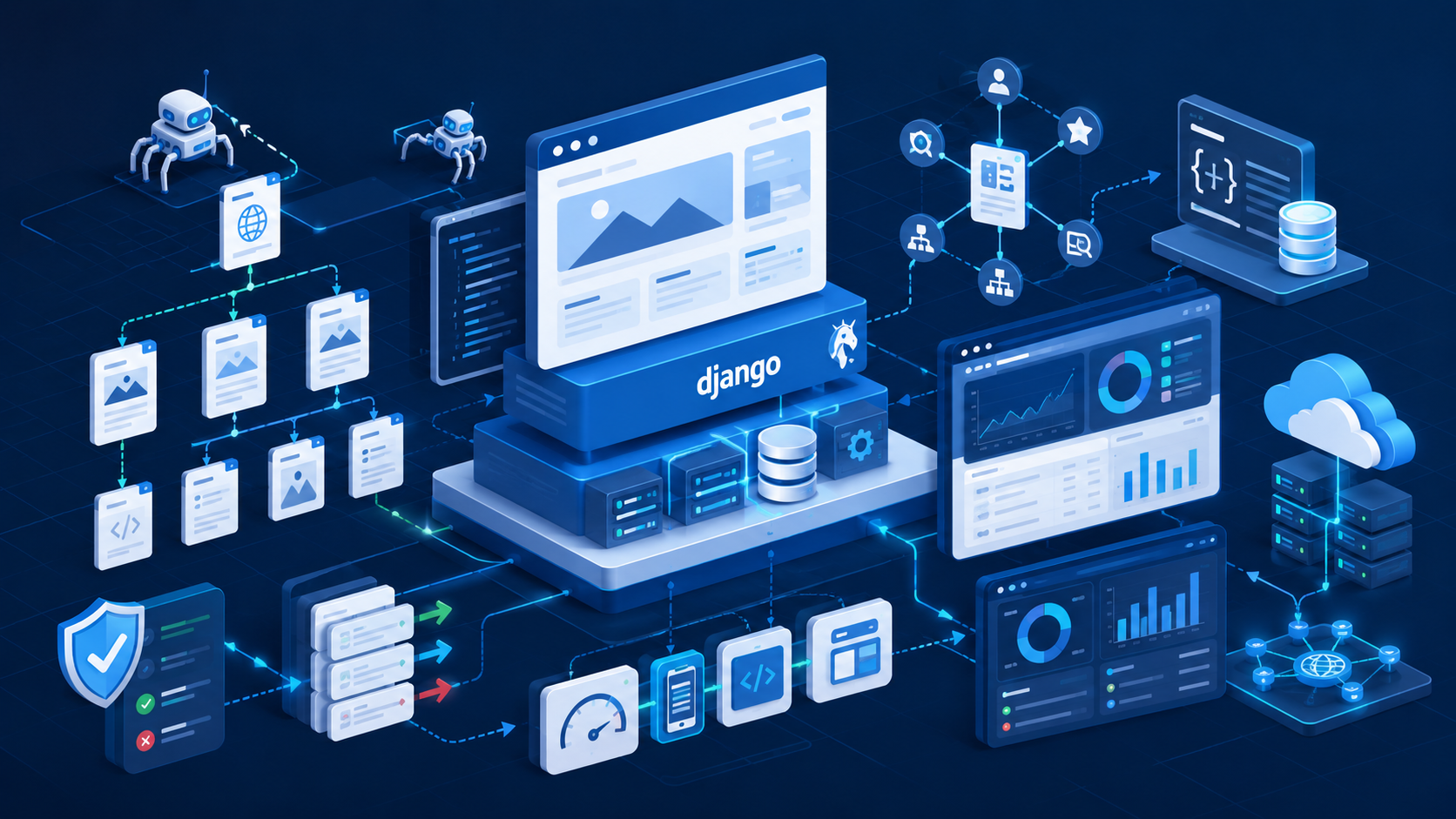
The best partners treat Django as a long-lived platform: explicit service layers, versioned migrations, background jobs for slow work, and observability before launch traffic. They can explain how your product map translates into apps, models, and API contracts without hiding engineers behind account managers.
Signals of a strong Django partner
Start with evidence, not adjectives. Ask for two case studies in your domain or complexity tier—multi-tenant B2B, subscription billing, partner APIs, or admin-heavy workflows. Review whether they own migrations, deployment, and post-launch support or only deliver code drops.
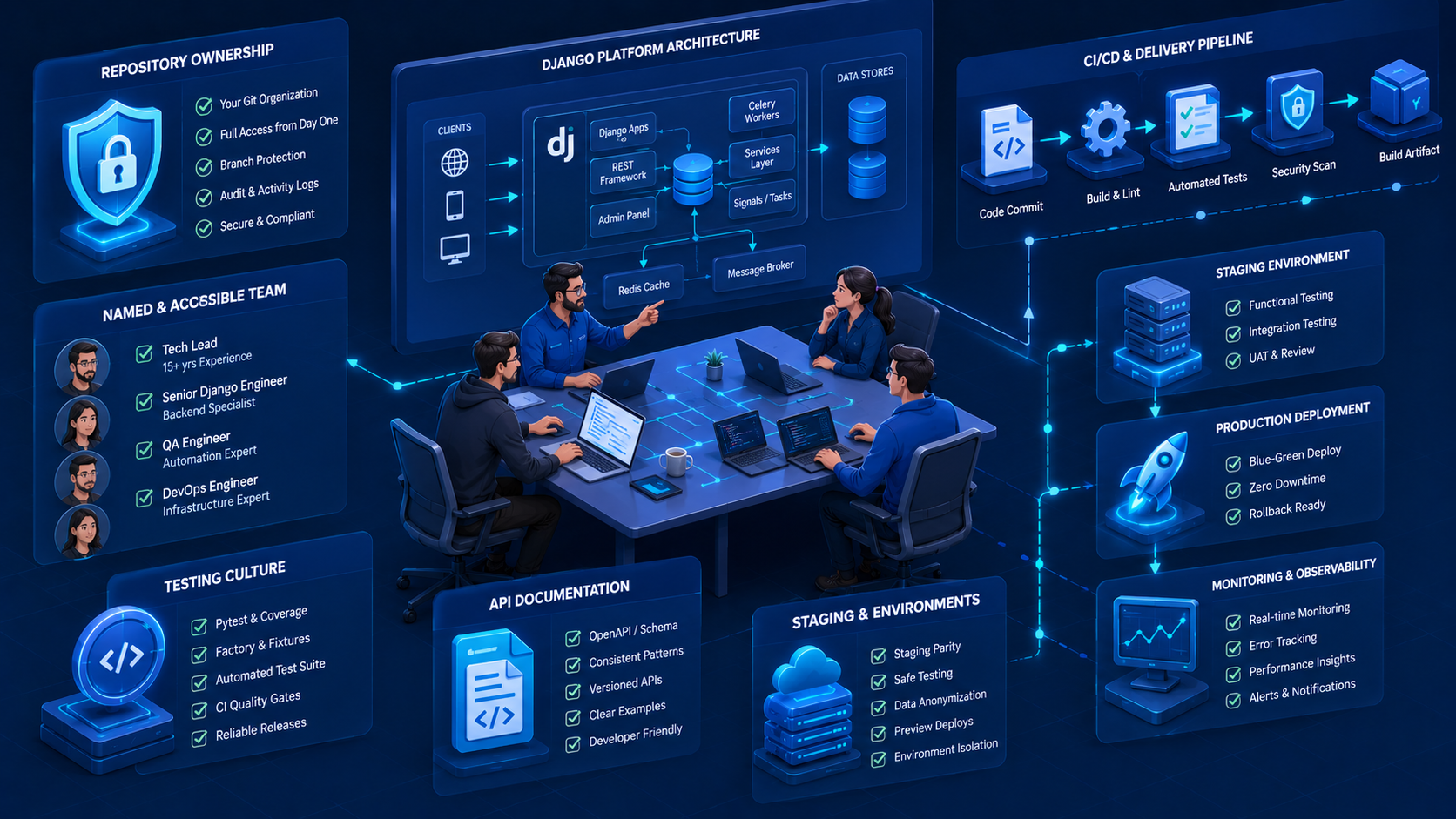
- Named team: You meet the tech lead and at least one senior engineer who will commit code in month one.
- Your repositories: IP and Git history live in your org from sprint one—not a vendor-hosted tarball at the end.
- Testing culture: They describe pytest coverage, factory patterns, and CI gates—not “QA at the end.”
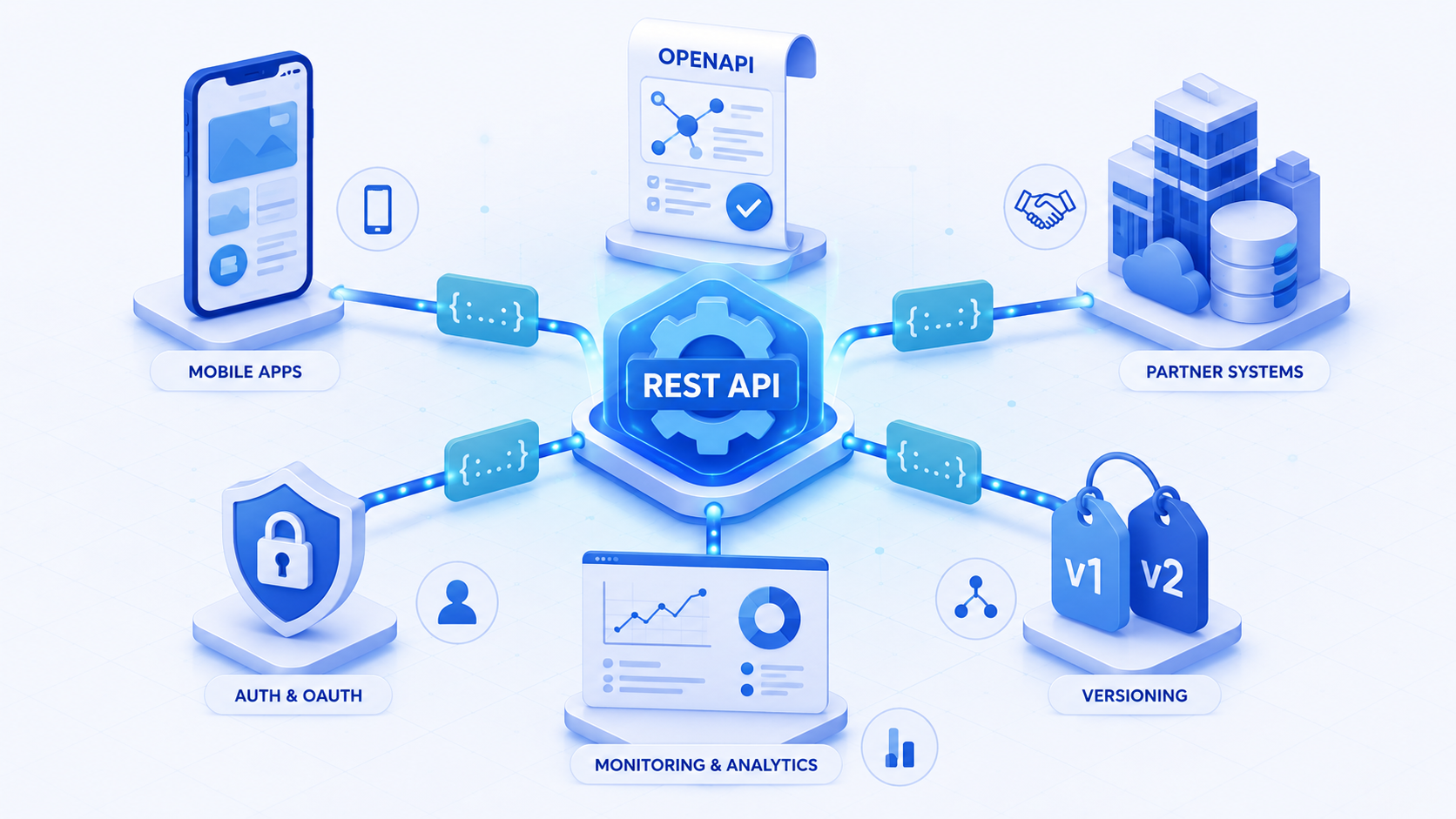
- API discipline: Serializers, OpenAPI or schema docs, and pagination patterns for future mobile or partner clients.
- Operational maturity: Staging environments, error monitoring, and runbooks—not SSH-and-hope deploys.
Questions to ask before you sign
These questions surface gaps faster than comparing hourly rates alone.
Architecture and scope
How do you structure Django projects for teams that will grow? Do you split domains into apps with clear boundaries? How do you handle multi-tenancy if we need it in year two? What is explicitly out of scope for MVP versus phase two?
Delivery rhythm
What does a weekly demo look like across time zones? How are blockers escalated? Who approves production deploys? Partners comfortable with US and UK clients document overlap hours and async written updates—not vague “we are agile.”
Quality and security
How are dependencies scanned? What is your policy on Django security releases? Do you perform OWASP-oriented review on auth and file uploads? For AI features, ask how LLM output is validated before it touches your database.
Red flags when evaluating vendors
Walk away from patterns that predict expensive rework: fixed bids on vague scope, refusal to show code samples, no staging URL during development, or “we will add tests later.” Be cautious when every answer is yes—mature shops push back on unrealistic timelines and propose phased delivery.
Offshore economics can work brilliantly when communication and ownership are clear. They fail when the vendor treats your product as a ticket queue without product context. Compare custom software partners on process fit, not country alone.
How SparkScribe approaches Django engagements
We embed Django service modules, Celery tasks, and admin extensions that match your domain—not generic boilerplate forks. Discovery produces a backlog with acceptance criteria, migration strategy, and integration map. We align with founders who want measurable launch criteria and engineering-led technical SEO on the same stack we build.
If you are comparing Django shops this quarter, share your roadmap and ask for a discovery proposal. We will answer transparently when we are not the right fit.
Building your shortlist efficiently
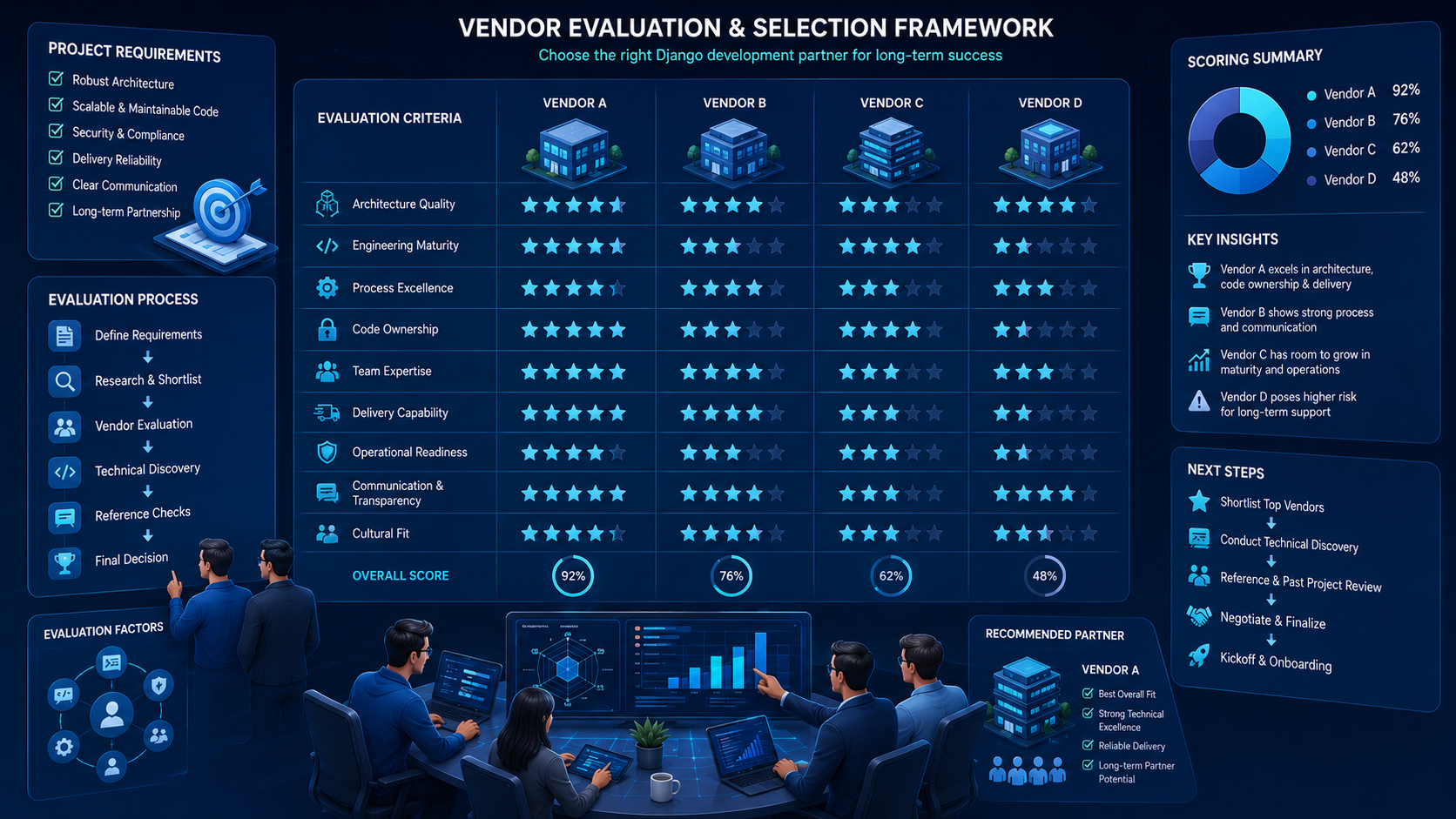
Start with five candidates from referrals and relevant case studies. Narrow to three after intro calls that cover team composition and repo ownership. Run reference calls on two finalists. A paid technical discovery sprint beats endless RFP loops—it reveals how vendors think about your data model and release path under real constraints.
Document scores in a simple matrix: domain fit, team access, process, quality bar, and total cost of ownership including your time. The Django company you choose will shape hiring, architecture, and vendor relationships for years—optimize for learning speed and trust, not the lowest bid.
Further reading
 Evaluate Django partners on architecture, delivery rhythm, and operational maturity—not framework buzzwords.
| Evaluation area | Strong signal | Weak signal |
|---|---|---|
| Team | Named engineers in kickoff | Rotating anonymous devs |
| Code ownership | Your Git org day one | Zip export at end |
| Quality | CI + pytest on every PR | Manual QA only |
| Scope | Written non-goals | Yes to every feature |
| Ops | Staging + monitoring | Production is the test env |
Is Django still a good choice for new SaaS in 2026?
Yes for B2B products needing admin tools, permissions, and rapid API delivery. Pair Django with React or mobile clients when UX demands it.
Django company vs freelance Django developer?
Freelancers fit narrow tasks; companies bring redundancy, process, and design/dev coordination. Match engagement size to risk.
How long should evaluation take?
Two to four weeks including reference calls and a scoped discovery proposal is reasonable.
The right Django partner argues about scope with you—not only about hourly rates.
Ready to compare? Book an intro call and we will walk through your stack and timeline.