


Key takeaways
- Scope complexity drives cost more than feature counts
- Senior oversight on offshore teams prevents expensive rework
- Budget for infra, AI usage, and compliance beyond dev hours
- Phased statements of work beat vague fixed bids
- Invest in QA and observability before cosmetic polish
- Discovery workshops produce estimates founders can fund confidently
Article content
Why generic cost calculators mislead founders
Search for custom software development cost in 2026 and you will find wide ranges - fifteen thousand to five hundred thousand for an MVP, often without defining scope, team location, or what done means. US and UK startups use these numbers for fundraising decks and vendor comparisons, then discover reality diverges once integrations, compliance, and AI features enter the conversation.
SparkScribe publishes transparent pricing thinking because aligned expectations produce better partnerships. This article breaks down how we estimate custom software cost for Django-backed web apps, mobile companions, and AI-enhanced products - and which levers actually move the budget.
Cost drivers that matter most
Four variables explain most variance: product scope, team composition, delivery timeline, and operational requirements. Scope is not feature count alone - it is domain complexity, data migration, third-party dependencies, and how polished the UX must be at launch.
Team composition balances seniority, stakeholder alignment across time zones, and specialty skills (ML, mobile, DevOps). A senior-heavy team costs more per month but often ships fewer rework cycles. Timeline compression raises cost nonlinearly - parallel workstreams, extended hours, and deferred QA all extract a premium.
Typical engagement shapes we see
- Discovery plus MVP (8–14 weeks): Validated prototype, core workflows, staging deployment, basic analytics - common for pre-seed and seed startups testing a market.
- MVP to production (3–6 months): Hardening, monitoring, billing, admin tooling, mobile API readiness - the path from demo to paying users.
- Ongoing product team (retainer): Predictable monthly capacity for roadmap execution, infrastructure, and support - favored by Series A teams without full in-house hiring.
- AI feature layer (4–10 weeks): RAG, copilots, or workflow automation added to an existing Django app - scope depends heavily on data readiness.
India delivery economics without quality trade-offs
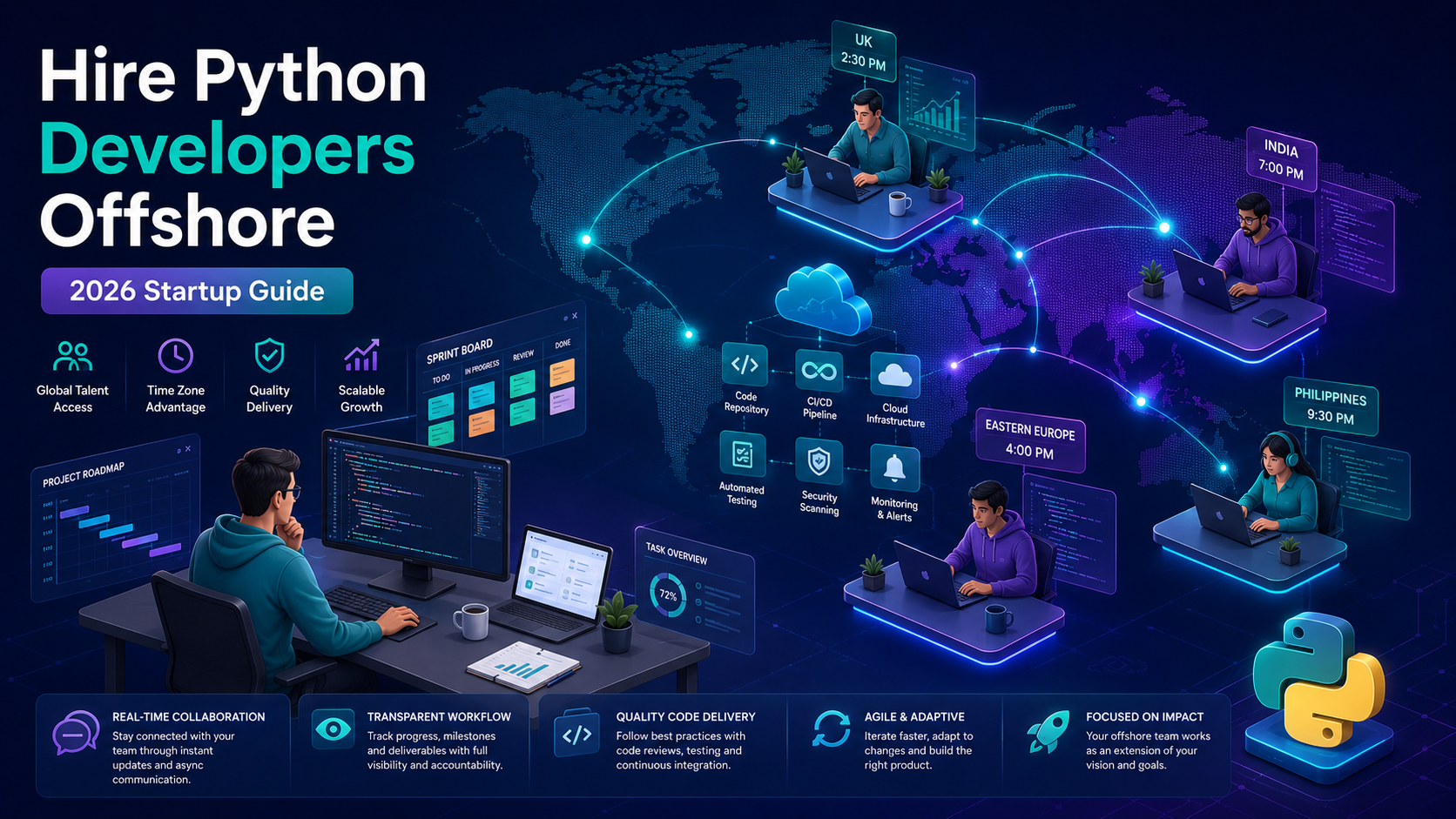
SparkScribe is headquartered in Surat, India. We work IST business hours with morning check-ins and EOD client summaries; live calls are agreed per engagement. Offshore development reduces blended rates versus purely US-based shops, but the savings should fund senior oversight and QA - not corner-cutting. We staff leads who have shipped production Django systems, enforce code review and automated tests, and keep client communication in a daily sync rhythm founders can follow asynchronously.
Hidden costs appear when vendors optimize for lowest hourly rate: rework, security gaps, and bus factor. We price engagements around outcomes and milestones, not opaque body shopping.
Line items founders forget to budget
Infrastructure and SaaS tools (hosting, error tracking, email, CI) typically run hundreds to low thousands monthly at MVP scale, scaling with usage. Apple and Google developer accounts, payment processor fees, and legal review for terms and privacy policies sit outside development contracts but hit cash flow.
AI features add model inference, embedding, and vector storage costs tied to usage - budget per active user scenarios, not flat estimates. Compliance (SOC 2 readiness, GDPR processes) may be post-MVP but should inform architecture early.
How to get a useful quote
Share user journeys, must-have integrations, example screens, and launch constraints. Ask vendors how they handle unknowns - fixed bids without discovery often hide change orders. Prefer phased statements of work with explicit acceptance criteria.
Request breakdown by milestone, team roles, and what is excluded (content entry, app store submission, penetration testing). Compare vendors on communication cadence and post-launch support, not price alone.
Benchmark ranges for 2026 (illustrative)
Exact numbers depend on scope, but US and UK clients budgeting with SparkScribe often land in these bands: focused MVP engagements from mid five figures USD, production-hardened platforms from low six figures, and retainers sized to roadmap velocity. AI additions range widely based on data prep and evaluation requirements.
We offer scoped discovery workshops that produce fixed estimates before major build spend. That investment pays off when it prevents a six-month build aimed at the wrong MVP.
Spend where it reduces risk
Prioritize architecture review, automated testing on critical paths, and observability before cosmetic polish. Founders who allocate budget to production readiness launch faster than those who treat QA as a leftover line item.
Ready to translate your roadmap into numbers? Start a conversation via our contact page or review custom software development aligned to MVP and scale-up stages.
Currency, contracts, and payment structure
US clients often budget in USD; UK clients in GBP. SparkScribe quotes in the currency of the contract with transparent conversion notes when materials reference both markets. Milestone invoices tied to demo acceptance reduce cash-flow risk versus large upfront deposits with vague delivery definitions. Retainers typically bill monthly against a agreed capacity plan with rollover rules documented upfront.
Change orders happen - the goal is making them visible early. When a founder adds mobile push notifications mid-sprint, something else should move out or timeline extends. Vendors who absorb unlimited scope silently either cut quality or exit the relationship frustrated. We prefer honest replanning conversations in weekly syncs over surprise invoices at launch.
Equity versus cash for early engagements
Some startups ask about equity-heavy arrangements. SparkScribe primarily works on cash milestones for clarity and mutual accountability, though selective strategic partnerships exist. Regardless of structure, define success metrics per phase - registered users, paid conversions, API uptime - so both sides know when to celebrate and when to replan.
Further reading

Budget allocation guide for seed-stage products
| Category | Typical share | Notes |
|---|---|---|
| Core product build | 55–65% | Features, APIs, admin, mobile readiness |
| QA and hardening | 15–20% | Tests, staging, performance fixes |
| DevOps and launch | 10–15% | CI/CD, monitoring, production deploy |
| Discovery / UX | 10–15% | Higher early; drops on retainers |
| Buffer for unknowns | 10% | Integrations and scope clarity |
Fixed price or time and materials?
Fixed milestones after discovery for defined scope; T&M for evolving research-heavy AI work. We avoid unlimited fixed bids on vague requirements.
Do you charge separately for project management?
Delivery leadership is included - sprint planning, demos, and stakeholder updates are part of our engineering engagements, not a separate line item.
How do AI features affect cost?
Data cleanup and eval tooling often exceed model API fees early on. Budget for retrieval quality work, not just OpenAI invoices.
What reduces cost without cutting quality?
Clear priorities, timely feedback, reusable design systems, and deferring nice-to-have integrations until after launch metrics validate them.
Request a scoped estimate with your roadmap and timeline - we respond with milestone options, not a single opaque number.