What the client needed
The founders had a notebook demo but needed a production LLM pipeline with cost controls, human review, and staging parity before investor diligence.
How SparkScribe approached it
Before build, SparkScribe worked with AstroSure to translate their SaaS Product goals into an actionable plan - not an off-the-shelf template.
Discovery & planning
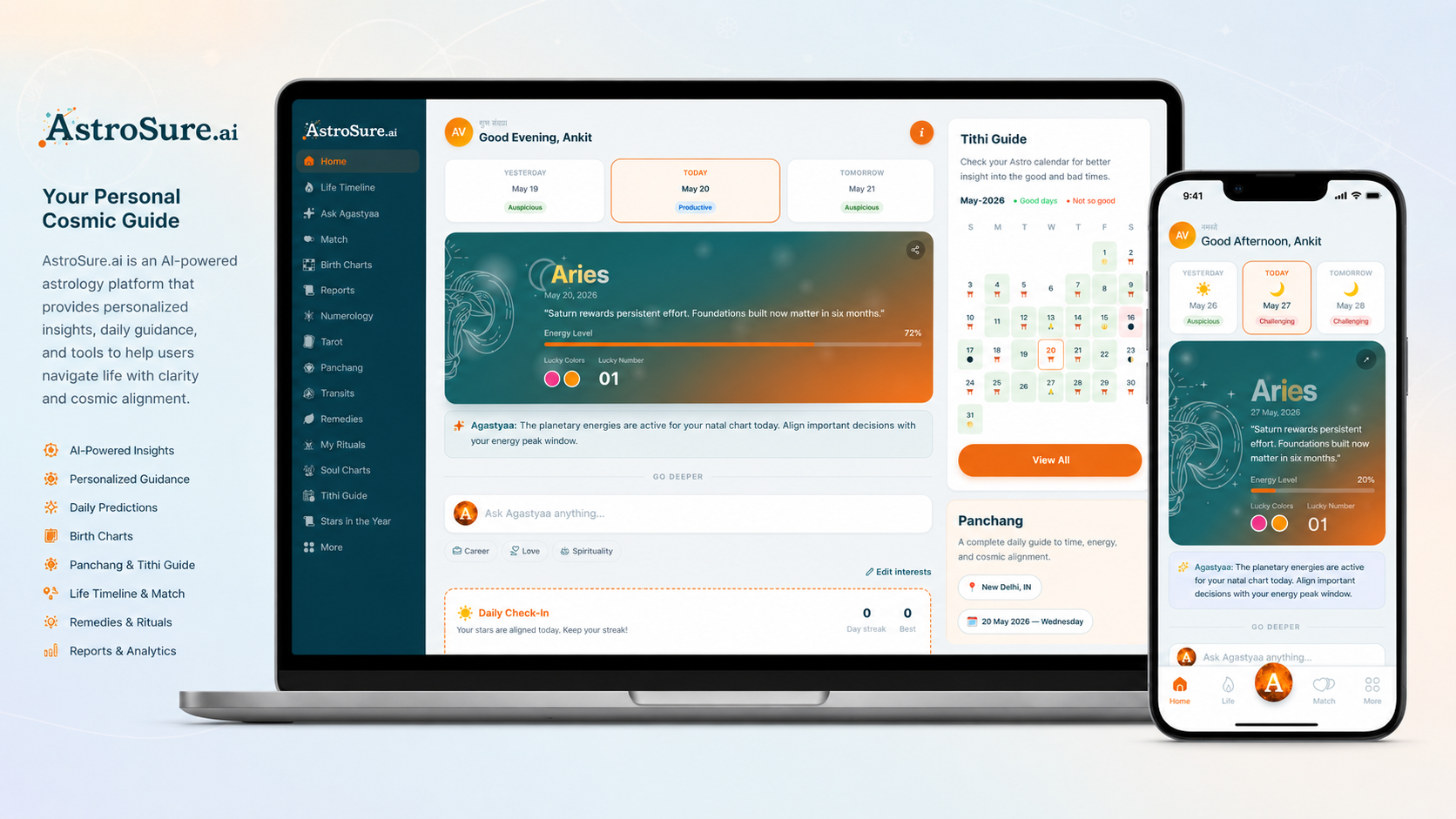
- Workshopped birth-chart, daily reading, panchang, kundli matching, and Agastya chat flows against latency and LLM cost targets.
- Prioritized admin-controlled prompt templates so product and content teams could iterate tone without redeploying code.
- Planned async generation, caching, and observability before scaling marketing - staging mirrored production early.
Our engagement covered Backend architecture, LLM integration, API design, Admin dashboard, Cloud deployment, Ongoing support - scoped in phases with staging parity and admin self-service so AstroSure could run day-to-day operations without waiting on engineering.
How we solved it
SparkScribe architected AstroSure as a modular Django platform with separate layers for user APIs, AI orchestration, and admin operations.
Backend and APIs
REST APIs cover user profiles, birth charts, daily readings, panchang data, compatibility matching, and the Ask Agastya chat experience. Redis caching and Celery workers handle repeat content and long-running generation without blocking requests.
LLM pipeline
Prompt templates, safety filters, and structured output parsing are managed through Django admin so the product team can iterate on tone and reading format without developer involvement for every copy change.
Operations
Role-based admin access, job monitoring, and feature flags gave the client visibility into usage and failed jobs from week one. We deployed on AWS with observability integrated early.
How we helped the client
AstroSure launched with a backend the team could operate independently. Daily readings and the Agastya chat experience became core retention drivers as the product scaled on web and mobile.
- Speed to iterate: Product and content teams adjust prompts and copy through admin without redeploying for most changes.
- Reliable delivery: Async workers and caching improved perceived response time for daily content and chat flows.
- Production readiness: Auth, subscriptions, and moderation paths were in place before major marketing pushes.
- Ongoing partnership: SparkScribe continues performance tuning and feature development as usage grows.
Technologies we used
Technologies we used
- Python
- Django
- OpenAI
- PostgreSQL
- Redis
- Celery
- React
- AWS
How we applied the stack
Django REST APIs power web and mobile clients. OpenAI sits behind structured prompt pipelines with safety filters and admin-managed templates. PostgreSQL stores users, charts, and subscriptions; Redis caches repeat content; Celery workers handle long-running generation. React delivers the consumer experience; AWS hosts production with monitoring integrated from the first release.